
From Dhoti to Trousers: The Evolution of What We Wear.
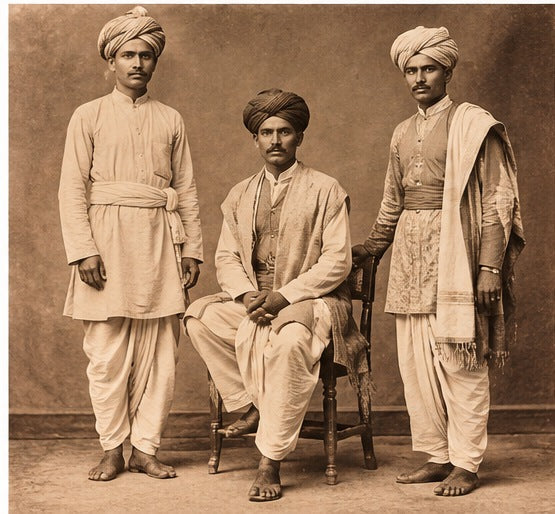
A journey through centuries of clothing, craftsmanship and changing lifestyles.
Before trousers became an everyday essential, people dressed very differently. Across ancient civilisations, clothing was often made by draping, wrapping and tying long pieces of fabric around the body.
In India, the dhoti was one of the most familiar examples of this tradition. Simple, versatile and suited to the climate, it was worn by generations of men. Across other parts of the world, robes, tunics, loincloths and wrapped garments served similar purposes.
So how did we arrive at the modern pair of trousers?
The answer lies in a fascinating combination of human movement, changing lifestyles, cultural exchange and the evolution of textile craftsmanship.
1. Before Trousers: The Age of Draped Clothing
For much of early human history, clothing did not need to be stitched into separate leg sections.
People used rectangular lengths of fabric, animal hides and other materials, wrapping or tying them around the waist and body.
In India, the dhoti became an enduring example of this approach. Its design allowed the wearer to adjust the fabric, move comfortably and adapt it to different occasions.
The beauty of draped clothing was its simplicity: a single length of fabric could be transformed into a practical garment without complicated tailoring.
And even today, the dhoti remains an important part of Indian cultural and traditional dressing.

2. The First Trousers: A Practical Innovation
One of the oldest surviving examples of trousers was discovered in the Yanghai cemetery in the Turfan region of western China.
Archaeologists dated the woollen trousers to approximately 3,000 years ago, around the 13th to 10th centuries BCE.
These were not trousers in the modern sense of fashion. They were practical garments, with separately formed legs joined by a specially constructed crotch section.
Why was this design important?
It allowed the wearer to sit astride a horse, travel longer distances and move more freely. Researchers believe that horseback riding and the mobility of ancient pastoral communities played an important role in the development and spread of trousers.
A simple idea had changed clothing forever: instead of wrapping fabric around both legs together, each leg could have its own tailored section.

3. How Trousers Spread Across Cultures
As people travelled, traded and came into contact with different civilisations, clothing traditions travelled with them.
Trousers and related stitched garments became established across parts of Central Asia, Persia and other regions.
They were particularly useful for riders, soldiers and people whose daily lives demanded movement and protection.
Over time, trousers became more than functional riding clothes. They developed into garments associated with different cultures, occupations, social positions and styles of dressing.
The same basic idea could be adapted into loose-fitting, close-fitting, layered or elaborately decorated forms.

4. India's Journey: From Dhoti to Pyjama, Churidar and Trousers
India's clothing history is not a story of one garment replacing another. It is a story of different traditions living alongside one another.
The dhoti continued to be worn across large parts of the subcontinent. Meanwhile, stitched garments such as pyjamas and other forms of trousers became established through centuries of cultural interaction.
During the Sultanate and Mughal periods, garments influenced by Central Asian and Persian traditions became prominent in courtly dressing. The jama, paired with fitted or gathered lower garments, became one example of this evolving style.
The churidar, with its close fit and distinctive folds around the ankles, became another familiar form.
Later, during the colonial period, Western-style trousers became increasingly visible in administration, education, professional life and urban dressing.
Gradually, tailored trousers became a regular part of everyday wardrobes for many Indians.
But the dhoti never disappeared. Both traditions continue to have a place in Indian life.

5. From Function to Fashion: The Evolution of Modern Trousers
As tailoring techniques developed, trousers became increasingly varied.
Different cuts and silhouettes emerged to suit different needs:
- Straight-fit trousers for a clean, timeless appearance.
- Pleated trousers for ease and a more traditional formal silhouette.
- Chinos for versatile everyday dressing.
- Denim jeans for durability and casual style.
- Formal trousers for professional and occasion wear.
Fabric technology also transformed the experience of wearing trousers.
Cotton brought breathability and everyday comfort. Linen offered a lightweight option for warmer climates. Blended fabrics introduced new possibilities for durability, wrinkle resistance and easier care.
Modern stretch fabrics took this evolution further, allowing garments to offer greater flexibility while retaining a smart appearance.
The trousers of today are the result of centuries of experimentation in both design and textile construction.
6. The Craft Behind Every Pair
A modern pair of trousers may look simple, but its construction involves many carefully considered details.
The fabric must be selected for its intended use. Patterns must be developed, pieces cut accurately and panels stitched with consistency.
The waistband, pockets, seams, closures and finishing all contribute to how the garment looks and performs.
Even small details matter: the fall of the fabric, the shape of the leg, the comfort around the waist and the quality of the stitching.
This is where the history of trousers meets the art of garment manufacturing.
A garment that began as a practical solution to movement has become an expression of design, comfort and craftsmanship.

7. The Journey Continues
From a simple length of draped cloth to carefully tailored garments, the history of trousers reflects how human needs and lifestyles have changed.
The dhoti, payjama, churidar and modern trouser each belong to a different chapter of this story. None makes the other less meaningful.
What connects them is the continuing human desire for clothing that feels comfortable, serves a purpose and reflects personal style.
At Botanica, we appreciate this journey. With roots in textiles dating back to 1980 and garment manufacturing experience since 1998, we believe that every pair of trousers carries more than fabric and stitching.
It carries the value of thoughtful design, material selection and attention to detail.
Botanica — We manufacture quality, not just garments.
The story of trousers is still being written, one carefully crafted pair at a time.